
Protecting Seniors. Supporting Safer Assisted Living.
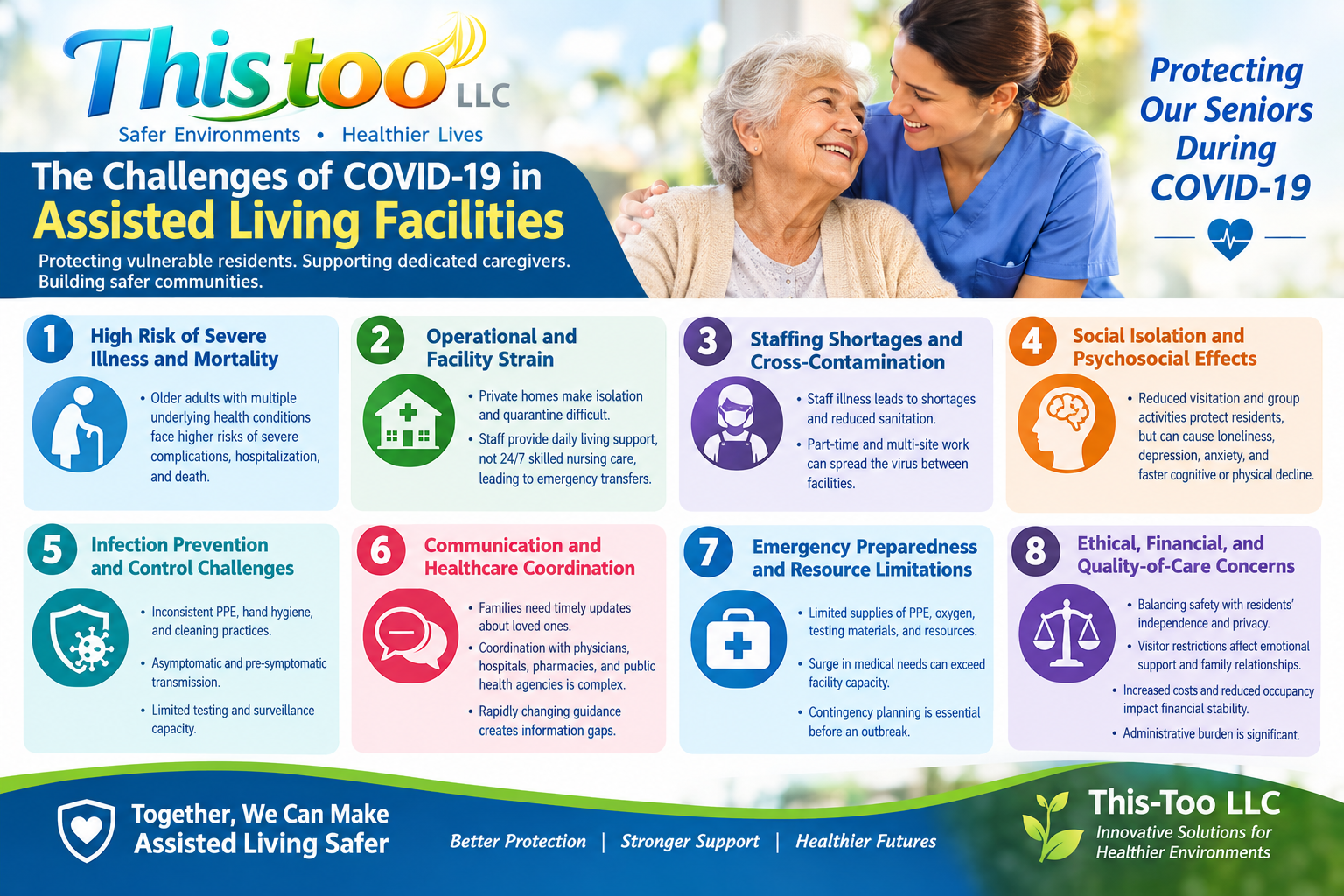
1. High Risk of Severe Illness and Mortality Vulnerable Demographics: Residents are typically older adults with multiple underlying health conditions (such as heart disease, diabetes, or respiratory issues). This drastically increases the risk of severe complications, hospitalization, and death compared to the public. Cognitive Barriers to Containment: A large percentage of residents suffer from dementia or cognitive impairments. This makes it incredibly difficult for them to remember or comply with masking protocols, social distancing, or room isolation, causing the virus to spread like wildfire.
2. Operational and Facility Strain Lack of Isolation Infrastructure: Assisted living apartments are private homes. When an outbreak occurs, executing strict medical isolation or transferring residents to dedicated quarantine areas is logistically incredibly difficult. Medical Care Discrepancy: These facilities are staffed to assist with daily living (like bathing and medication management), not to provide 24/7 skilled nursing care. If a resident's respiratory symptoms worsen rapidly, the facility must organize immediate emergency transfers to already overwhelmed hospitals.
3. Severe Staffing Shortages and Cross-Contamination Caregiver Illness: When staff members inevitably contract the virus, it triggers acute staffing shortages. Overworked employees have less time for meticulous sanitation, raising the risk of cross- contamination. Multi-Site Vectors: Many assisted living staff work part-time or across multiple senior care locations. This means a caregiver can inadvertently carry the virus from one local facility straight into another.
4. The Hidden Toll: Isolation and Mental Health Lockdown Side Effects: To protect residents, facilities must restrict family visitation and halt communal dining or group activities. Rapid Decline: For older adults, prolonged confinement to a single room often triggers severe depression, anxiety, and a rapid acceleration of cognitive decline or physical frailty due to lack of movement and human contact.
5. Infection Prevention and Control Challenges Difficulty Implementing Standard Precautions: Assisted living communities may face challenges maintaining consistent use of personal protective equipment (PPE), hand hygiene, environmental cleaning, and respiratory precautions during an outbreak. Asymptomatic and Pre-Symptomatic Transmission: Residents and staff may transmit COVID-19 before symptoms become apparent, making it difficult to identify cases early and prevent exposure to others. Limited Testing and Surveillance Capacity: Frequent testing, contact tracing, and monitoring of symptoms require additional personnel, supplies, and organizational resources, which may place significant pressure on facility operations. 6. Communication and Coordination Challenges Communication With Families: Outbreak-related restrictions can make it difficult for families to receive timely information about their loved one's health and changes in facility policies. Coordination With Healthcare Providers: Assisted living facilities must often coordinate with physicians, hospitals, pharmacies, public health agencies, and emergency medical services during an outbreak, creating additional administrative demands. Information Gaps: Rapidly changing public health guidance can make it challenging for administrators and staff to maintain consistent infection-control practices.
7. Emergency Preparedness and Resource Limitations Limited Medical Resources: Facilities may not have sufficient supplies of PPE, oxygen equipment, testing materials, or other resources needed during a large outbreak. Emergency Response Capacity: A sudden increase in residents requiring medical attention can exceed the facility's normal capabilities and require rapid coordination with external healthcare systems. Need for Contingency Planning: Facilities must develop plans for isolation, staffing shortages, resident transfers, supply shortages, and communication with families before an outbreak occurs.
8. Ethical and Quality-of-Care Concerns Balancing Safety and Autonomy: Infection-control measures may conflict with residents' independence, privacy, freedom of movement, and ability to make personal decisions. Restrictions on Family Contact: Limiting visitors may reduce infection risk but can also interfere with residents' emotional support and family relationships. Equitable Access to Care: During periods of limited healthcare capacity, facilities may face difficult decisions regarding hospital transfers and access to medical treatment.
9. Financial and Administrative Impact Increased Operating Costs: Outbreaks can increase expenses associated with PPE, testing, environmental cleaning, overtime, temporary staffing, and medical transportation. Revenue and Occupancy Effects: Prolonged outbreaks or negative perceptions of infection risk may affect admissions, occupancy, and the financial stability of a facility. Administrative Burden: Administrators must simultaneously manage infection-control requirements, staffing concerns, resident care, family communication, documentation, and regulatory responsibilities. A concise academic structure If you want the section to remain relatively short, you could organize the primary problems into these eight categories: 1. High Risk of Severe Illness and Mortality 2. Operational and Facility Strain 3. Staffing Shortages and Cross-Contamination 4. Social Isolation and Psychosocial Effects 5. Infection Prevention and Control Challenges 6. Communication and Healthcare Coordination 7. Emergency Preparedness and Resource Limitations 8. Ethical, Financial, and Quality-of-Care Concerns For an academic paper, I would also replace phrases such as “spread like wildfire,” “inevitably contract,” and “incredibly difficult” with more objective language such as “rapid transmission,” “increased risk of staff infection,” and “substantial operational challenges.”
THIS TOO LLC NEWS
New Research Shows UV-C Exposure Time and Distance Matter in Fighting Candida auris
September 2026 | This Too LLC News
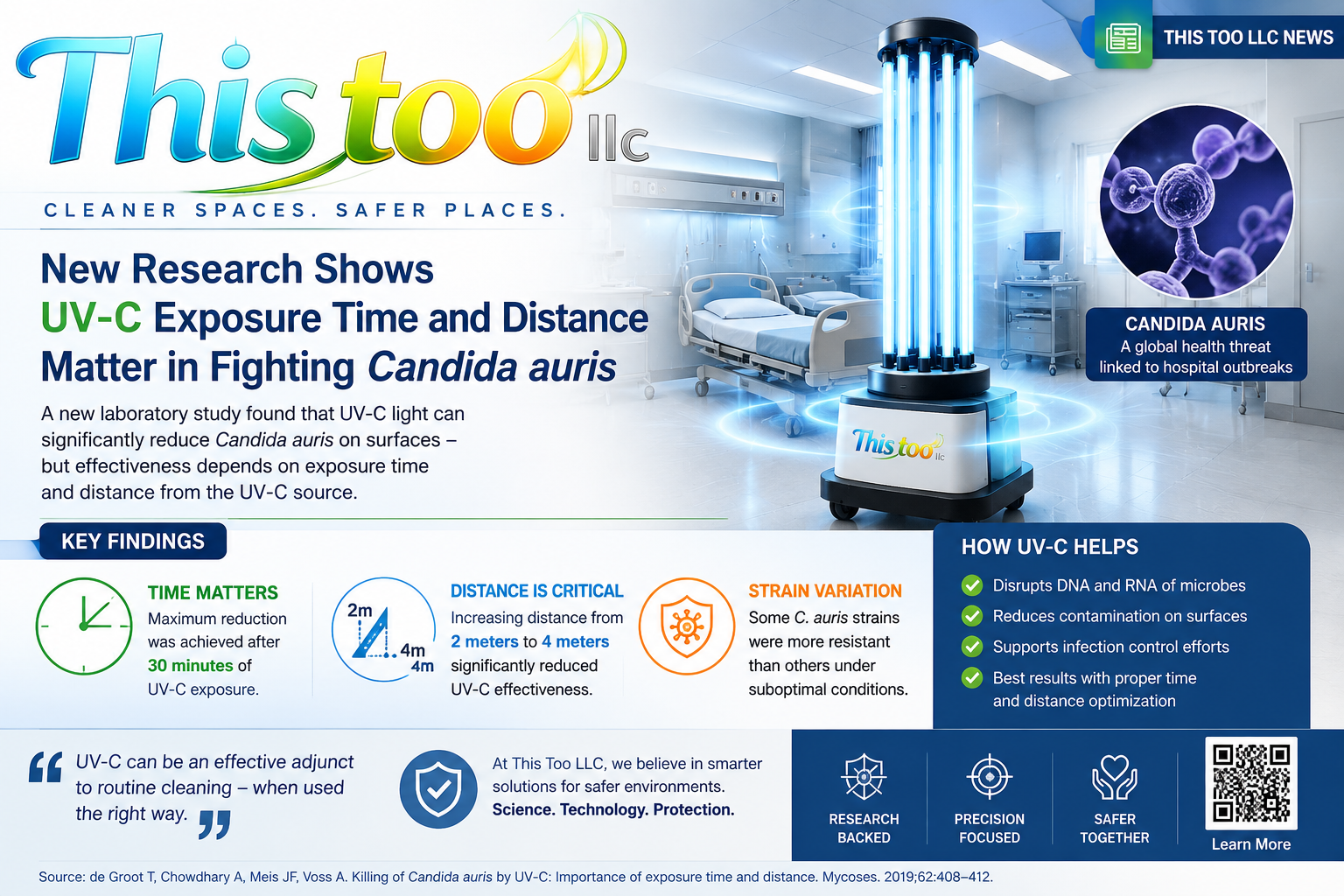
Researchers studying Candida auris, an emerging fungal pathogen associated with healthcare outbreaks, have found that ultraviolet-C (UV-C) light can reduce the organism on surfaces—but the effectiveness depends heavily on how long the surface is exposed and how far it is from the UV-C source.
The findings were published in Mycoses in a study led by researchers from the Netherlands and India.
Why Candida auris Matters
Candida auris has become an important healthcare concern because it can cause serious infections and can persist on surfaces and patient-care equipment. Contaminated surfaces may contribute to transmission between patients.
Traditional environmental cleaning and disinfection remain important tools for infection control. Researchers have also investigated UV-C as a possible additional method for environmental decontamination.
Longer Exposure Produced Greater Reduction
In the study, researchers placed C. auris on glass surfaces and exposed the samples to UV-C radiation for different periods.
The researchers tested exposure times of 5, 10, 20 and 30 minutes at a distance of 2 meters, and also examined the effect of increasing the distance to 4 meters.
The strongest reduction was observed after 30 minutes of exposure at 2 meters.
The study also found that increasing the distance from 2 meters to 4 meters substantially reduced UV-C effectiveness. Higher concentrations of the organism also made complete reduction more difficult.
Distance Is Critical
According to the researchers, both exposure time and distance are critical factors when using UV-C for surface decontamination.
At suboptimal conditions, some C. auris strains were more resistant to UV-C than others. The researchers observed differences between strains originating from different geographic regions.
This means that simply placing a UV-C device in a room does not guarantee the same level of microbial reduction on every surface.
What This Means for Healthcare Facilities
The researchers concluded that UV-C may have potential as an adjunct to routine environmental cleaning, particularly when exposure time and distance are properly optimized.
However, the study was performed under controlled laboratory conditions. The authors emphasized the need for additional research to determine how UV-C performs in actual healthcare environments and whether its use can reduce C. auris transmission or healthcare-associated infections.
This Too LLC Perspective
The research highlights an important principle in environmental sanitation: technology works best when it is used according to the conditions under which it has been tested.
For UV-C systems, factors such as exposure time, distance, surface orientation, organism concentration, and equipment design can influence results.
UV-C should therefore be viewed as a potential supplement to established cleaning and disinfection procedures, rather than automatically replacing them.
Source: de Groot T, Chowdhary A, Meis JF, Voss A. Killing of Candida auris by UV-C: Importance of exposure time and distance. Mycoses. 2019;62:408–412.
This Too LLC News is an informational publication. The information above does not constitute medical advice or a recommendation to use UV-C equipment for healthcare decontamination.